

Astro Charts


Natal Chart Reading
A natal or birth chart reading is an astrological interpretation of the positions of celestial bodies at the exact moment of a person’s birth. These celestial bodies include the Sun, Moon, planets (e.g., Mercury, Venus, Mars), asteroids, and other celestial points (e.g., the Ascendant or Rising Sign, Midheaven). Astrologers use this chart to gain insights into an individual’s personality, strengths, weaknesses, life path, and potential life events. Here’s a breakdown of what a natal chart reading typically involves:
Chart Creation: To create a natal chart, an astrologer needs the following information: the date, time, and place of birth. The date and place are self-explanatory, but the exact time of birth is crucial because it determines the positions of the planets in the chart.
The Zodiac Signs: The natal chart is divided into 12 segments, each representing one of the 12 zodiac signs (Aries, Taurus, Gemini, etc.). The position of the Sun at the time of birth determines an individual’s Sun sign, which is the most commonly known astrological sign.
The Houses: The chart is further divided into 12 houses, each associated with specific life areas (e.g., House of Career, House of Relationships). The positions of planets within these houses provide insights into various aspects of an individual’s life.
The Planets: The positions of the planets in the chart are mapped out within the zodiac signs and houses. Each planet represents different aspects of an individual’s personality and life experiences. For example, Venus is associated with love and relationships, while Mars is associated with action and ambition.
Aspects: Aspects are angular relationships between the planets in the chart. Common aspects include conjunctions (when planets are close together), sextiles (60-degree angles), squares (90-degree angles), trines (120-degree angles), and oppositions (180-degree angles). Astrologers analyze these aspects to understand how the planets interact and influence each other.
Rising Sign: The Ascendant or Rising Sign is the zodiac sign that was on the eastern horizon at the time of birth. It represents the individual’s outward behavior, first impressions, and physical appearance.
Moon Sign: The position of the Moon in the natal chart is crucial for understanding emotions, instincts, and the individual’s emotional needs.
Interpretation: The astrologer interprets the natal chart by analyzing the relationships between the planets, signs, houses, and aspects. This interpretation can provide insights into an individual’s personality traits, career tendencies, relationships, strengths, challenges, and life purpose.
Timing and Transits: Astrologers may also consider current planetary transits and progressions, which involve the movement of celestial bodies in the sky in relation to the natal chart. This can offer insights into timing and potential life events.
Guidance: A natal chart reading often includes guidance and recommendations based on the astrologer’s insights. This guidance can help individuals make informed decisions, understand their life path, and navigate challenges more effectively.
Astro Charts Info
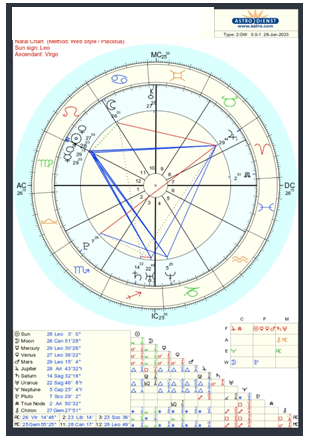
- Client Name: Francisco Hanson
- Place of Brith: Italy, Andaman
- Time of brith: 03:20 pm
- Brith Date: February 12, 2022
Example of a birth chart created by astro.com
It’s important to note that astrology is considered a pseudoscience by the scientific community, and its interpretations are subjective. Therefore, individuals should approach natal chart readings with an open mind and consider them as a form of personal insight rather than definitive predictions. Many people find natal chart readings to be a valuable tool for self-reflection and personal growth.
Synastry Chart
Compares the individual birth charts of two people to understand how they interact with each other on a personal level. It highlights individual strengths and weaknesses in the relationship.
Synastry Chart
In astrology, compatibility charts are used to assess the potential compatibility and dynamics between two individuals, often in the context of romantic or interpersonal relationships. There are three primary types of compatibility charts: Synastry charts, Composite charts, and Relationship charts (also known as Davison charts). Let’s explore each of them:
Synastry Chart:
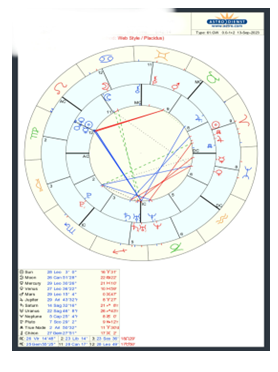
- A synastry chart is a comparison of the birth charts of two individuals. It’s a tool used to analyze how the planets in one person’s chart interact with the planets in the other person’s chart.
- In a synastry chart, astrologers examine the aspects (angular relationships) between the planets of both individuals. Aspects like conjunctions (when two planets are in close proximity), sextiles, squares, trines, and oppositions are analyzed.
- Each aspect represents a different type of interaction. For example, conjunctions may signify a strong connection or fusion of energies, while squares can indicate tension or challenges in the relationship.
- The synastry chart provides insights into the strengths and weaknesses of the relationship, areas of compatibility, and potential areas of conflict.
Example of a synastry chart
Composite Chart:
Represents the relationship as a separate entity with its own qualities, purpose, and challenges. It doesn’t focus on the individuals’ traits but rather on the dynamics of the relationship itself.
Composite Chart:
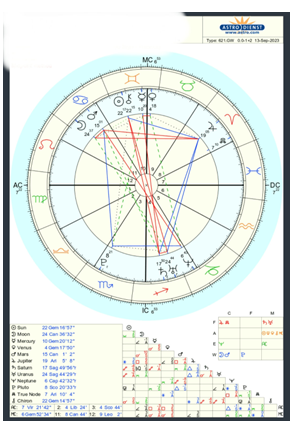
- A composite chart is created by taking the midpoints between the positions of each planet in the birth charts of two individuals. Essentially, it calculates an “average” chart that represents the relationship itself, rather than the individuals.
- This chart is viewed as the birth chart of the relationship and is analyzed in its own right. It provides insights into the dynamics and purpose of the relationship as a separate entity.
- The aspects between planets in the composite chart are also analyzed, but these aspects are seen as qualities of the relationship itself rather than individual characteristics.
- The composite chart is useful for gaining a deeper understanding of the shared goals, challenges, and the overall purpose of the relationship.
Example of a Composite Chart:
In summary, synastry charts focus on the compatibility of two individuals, while composite and relationship charts delve into the dynamics and purpose of the relationship itself, helping individuals gain a deeper understanding of their connections with others.